Friday, February 14, 2020

Photos from FACAM 2020 Workshop at USC

Here are some photos of the inspiring presentation of our experts.


 Welcome Banquet at Downtown LA


 Prof. Nabil Anwer gave a talk about "Geometrical Product Specifications Challenges 
and Opportunities in Additive Manufacturing"


 Prof. Xianfeng Gu gave a lecture about "Surface Registration 
and Comparison Based on Conformal Geometry"


 Prof. Linkan Bian presented the research about Predicting the Fatigue Performance 
of Additively Printed Metal Parts Using In-Situ Monitoring


 Prof. Ahmed QURESHI gave a talk about "Understanding Process Drivers 
for Variability and Tolerancing in Additive Manufacturing"


 Prof. Hui Wang presented his research about "Multi-printer Co-learning 
of Kinematics-induced Variations For Extrusion-based Additive Manufacturing" 

Nathan Decker presented the smart 3D printing accuracy control software
"PrintFixer" developed by USC Huang Lab


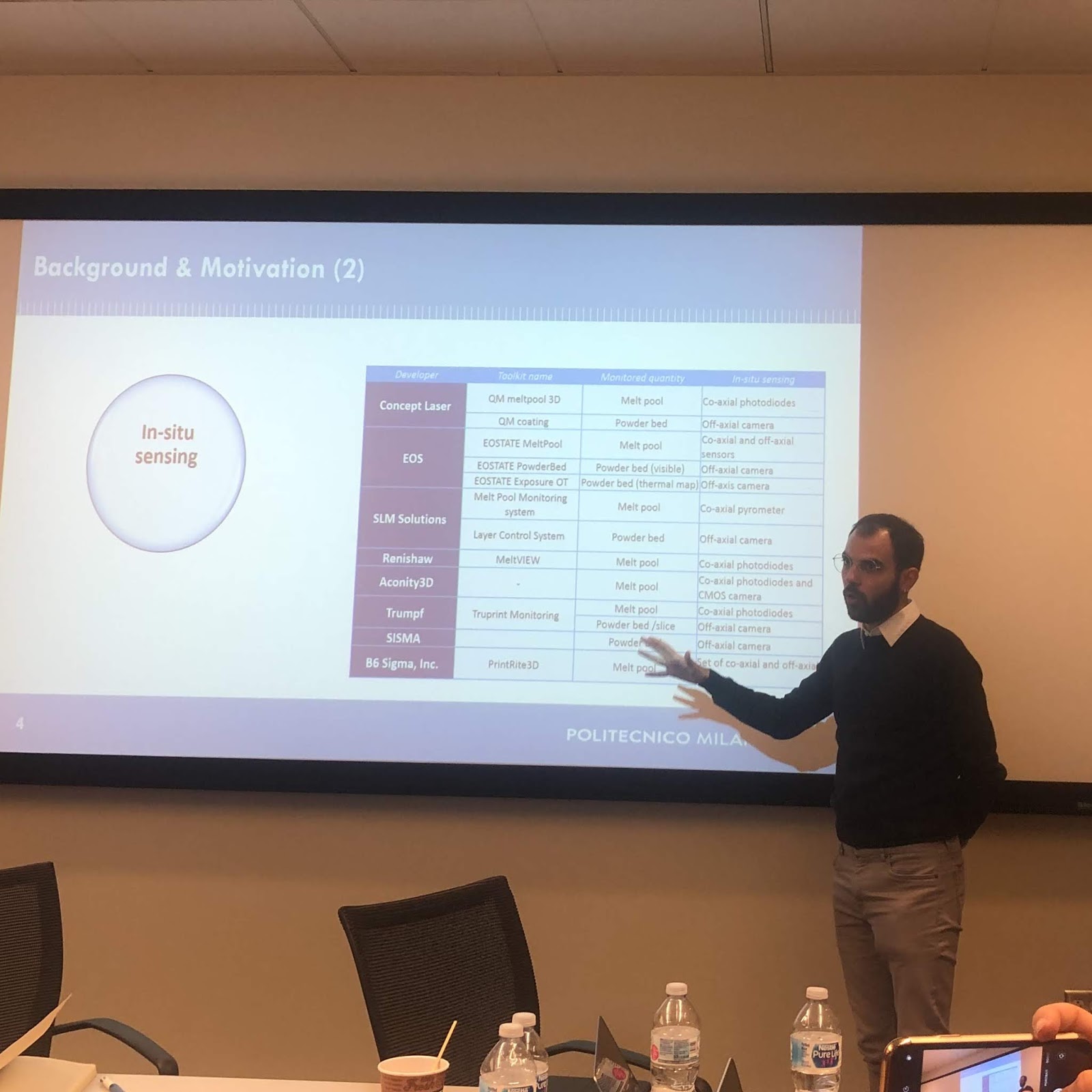
 Fabio Caltanissetta presented the research about 
"Opportunities and challenges of in-situ monitoring in AM: an update"

 Zhaohui Geng presented the research about "Freeform Tolerance Specification 
and Metrological Analysis of Reverse Engineered Models"


Yuanxiang Wang presented the research about "A Convolution Learning and Prediction of 3D Freeform Shape Accuracy for Additive Manufacturing"

Wednesday, February 12, 2020

FACAM 2020 Workshop Agenda


FACAM 2020 Agenda
10-Feb
Location: GER 206, USC


1:30 PM
Prof. Q. Huang (USC)
Welcome and Introduction
2:00 PM
Prof.Nabil Anwer (ENS Paris-Saclay) 
Geometrical Product Specifications Challenges and Opportunities in Additive Manufacturing
3:00 PM
Prof. Tirthankar Dasgupta (Rutgers U)
Sequential learning of deformation models in additive manufacturing using adaptive data augmentation strategies
4:00 PM
Prof. Xianfeng (David) Gu (Stony Brook)
Surface Registration and Comparison Based on Conformal Geometry
5:00
Break


5:30 PM
Welcome Banquet at Downtown LA


11-Feb
Location: RTH 306, USC

Chair: Prof. Anwer (ENS Paris-Saclay)
9:00 AM
Refreshment
9:00 AM
Prof. Linkan Bian (MSU)
Predicting the Fatigue Performance of Additively Printed Metal Parts Using In-Situ Monitoring
9:45 AM
Prof. Ahmed QURESHI (U of Alberta)
Understanding Process Drivers for Variability and Tolerancing in Additive Manufacturing
10:30 AM
Zhaohui Geng, PhD Student, with Prof. B. Bidanda (U of Pittsburgh)
Freeform Tolerance Specication and Metrological Analysis of Reverse Engineered Models
11:15 AM
Nathan Decker (lead), Mingdong Lyu, Yuanxiang Wang, PhD Students (USC)
PrintFixer: Smart 3D Printing Accuracy Control Service


12:00 PM
Box lunch at RTH 306


Chair: Prof. Dasgupta (Rutgers U)
1:30 PM
Prof. Hui Wang (FSU)
Multi-printer Co-learning of Kinematics-induced Variations For Extrusion-based Additive Manufacturing 
2:15 PM
Fabio Caltanissetta, PhD student, with Prof. Marco Grasso, Prof. Bianca Colosimo (Politecnico di Milano) 
Opportunities and challenges of in-situ monitoring in AM: an update
3:00 PM
Yuanxiang Wang, PhD Student (USC)
A Convolution Learning and Prediction of 3D Freeform Shape Accuracy for Additive Manufacturing
3:45 PM
Discussions
4:30 PM
adjourn

Tuesday, January 7, 2020

FACAM Workshop 2020 Information

This post will contain all of the logistical information for the 2020 workshop, hosted on USC's campus from February 10th to 11th.

It will be continually updated as plans are finalized.

Hotel Information

Participants are encouraged to stay at the USC Hotel.  In order to qualify for an internal USC discount, please provide your check in/check out dates to Prof. Huang (qiang.huang@usc.edu), or Nathan Decker (ndecker@usc.edu), who will make your reservation for you.

Talks

Once you've finalized your working title, please send it to Prof. Huang or Nathan Decker.

Activities

Optional activities are planned for after the conclusion of sessions on Monday and Tuesday.  Participants will be able to explore Los Angeles, and enjoy great food.

Transportation/Navigation Information

For those who wish to use Uber/Lift get to/from LAX, there is now a rideshare pickup/drop-off area that is used.  Info can be found here.

Public transit options between LAX and the USC are also available, but will require a bus and a train.

Sunday, November 3, 2019

Thursday, August 22, 2019

A New Machine Learning for Additive Manufacturing (ML4AM) Project on Shape Deviation Generator and Learner


A new machine learning for AM (ML4AM) project, "NSF CMMI-1901514: Shape Deviation Generator and Learner- An Engineering-Informed Convolution Modeling andLearning Framework for Additive Manufacturing Accuracy Control", has been funded by US National Science Foundation. (PI: Huang, $350K, 08/2019∼ 07/2022).  The grant abstract is given below.


Although additive manufacturing (AM), known as 3D Printing, holds great promise as a direct manufacturing technology, significant deviations from the desired part shape often occur in the printed parts.  As a result, shape distortion control is a critical issue for AM built products. With advances in computing and increased accessibility of AM product data, machine learning for AM has become a viable strategy for enhancing 3D printing performance. However, meaningful learning of engineering data requires effective integration of domain knowledge, making general-purpose machine learning methods difficult to apply. As a result, there is a critical need for an engineering-informed, data-analytical, machine learning framework for shape distortion control.  Such a tool is essential to improving AM quality and reducing cost and waste.


The project will establish an engineering-informed convolution modeling and learning methodological framework for AM distortion control. A Shape Deviation Generator and Learner for shape accuracy control will be researched by: (1) modeling 3D shape deviation generation by establishing a new convolution formulation for layer-by-layer fabrication processes, (2) transferring the 3D shape deviation model from a small set of training shapes to a wider variety of shapes by exploring and learning shape similarity under a cookie-cutter modeling framework, (3) transferring the shape deviation model between AM processes by exploring and learning process similarity through an effect equivalence framework, and (4) validating modeling and transfer learning methodologies in both polymer and metal AM processes. Methodologies and tools will be developed to mitigate both shape and process complexities towards the goal of building AM products with high geometric fidelity: from single shape to multiple shapes, and from single process to multiple AM processes.
 

Friday, July 26, 2019

Position Opening at HP Labs, Palo Alto: Deep Learning Scientist for 3D Printing


HP Labs’ 3D Lab (3DL) invents next generation 3D printing technology and novel materials, and creates their digital twins to enable digital manufacturing.  A key technical foundation that delivers precision manufacturing at voxel level such as HP’s Multi Jet Fusion technology is ubiquitous sensing for both machine and products, and process control based on continuous sensing data stream enriched by physics.  HP’s Multi Jet Fusion 3D printers have been in production worldwide; each production build generates terabytes of data from geometrical processing to in-situ thermal sensing. 3DL has created a highly promising research in applying deep learning to these datasets –  a single production build of terabytes,  different builds for a single machine, and different builds by different machines in different geographical location.  We are expanding this deep learning research project to accelerate our preliminary success.  We are inviting you to join our journey. 

We expect you an accomplished deep learning specialist, in particular,
  1. PhD (preferred) in engineering and/or applied physics from reputable universities and research programs. Multiple years of independent research with demonstratable outcome.
  2. Hands on experiences in deep learning; experiences with recurrent neural network (e.g., LSTM) is a plus. Experiences with generative adversarial networks and/or reinforcement learning a plus.
  3. Hands on experiences in established platforms; Tensorflow experience is a plus.
  4. Hands on experiences in applying deep learning to analyze sensing data in the form of images, videos.
  5. Research experiences on applying deep learning to solve scientific problems; some hardware/physical science background is a plus. 
  6. Willing to lead research; willing learn and teach.

More details can be found from
https://h30631.www3.hp.com/job/palo-alto/machine-learning-scientist-for-3d-printing-research/3544/13031902

  Contact:  Dr. Zeng (Email: jun.zeng@hp.com)

Monday, July 1, 2019

Summary of FACAM 2019 Workshop


Co-organized by Prof. N. Anwer (ENS Paris-Saclay), Prof. C. Mehdi-Souzani (ENS Paris-Sacaly), and Prof. Q. Huang (USC), the third FACAM 2019 workshop was held on June 17th and 18th at ENS Paris-Saclay (Cachan).  Other than organizers, the participants include Dr. AF Obaton (LNE of French Metrology Institute), Prof. J. Liu (University of Arizona), Prof. R. Jin (Virginia Tech), Prof. M. Grasso (Politecnico di Milano), and graduate students  Zuowei Zhu, Yahya Al Meslem, Kevin Pereirrai (ENS Paris-Saclay), Baltej Rupal (ENS Paris-Saclay/University of Alberta), Saint-Clair Toguem Tagne (LNE/ENS Paris-Saclay), Charles Cayron(LNE), Yuanxiang Wang, Nathan Decker, and Chris Henson (USC).

Prof. Anwer opened the workshop by welcoming everyone and gave an introduction of the Advanced and Smart Manufacturing research at the LURPA research lab and AM Initiatives at ENS Paris-Saclay. Dr. Obtaton’s presentation introduced metrology challenges in AM and opportunities for statistical analysis and machine learning of metrology data. Prof. Grasso presented novel solutions for in-situ monitoring of metal AM. Baltej Rupal discussed geometric Benchmark test artifacts design for GD&T quantification. Dr. Huang presented a new convolution framework for learning and predicting shape accuracy in AM. Zuowei Zhu and Kevin Ferreira presented a data-driven Skin Model Shapes  and deep learning for AM. Nathan Decker ended the first day by presenting dimensional accuracy prediction using machine learning of triangular mesh data.  

On the second day of the workshop Prof. Liu presented the spatio-temporal modeling of photothermal curing process for glass printing. Prof. Jin discussed  data fusion for quality modeling in AM processes and network. Yuanxiang Wang, Nathan Decker, and Chris Henson presented a software prototype demo of cloud-based machine learning for 3D printing distortion control. In the afternoon session, Prof. Huang led the discussion on the collaboration opportunities and new research problems arising from the presentations and follow-up questions.  Prof. C. Mehdi-Souzani, Prof. Liu, Prof. Grasso, and Prof. Jin made great remarks (Prof. Anwer left earlier due to a conference). A whitepaper is expected to produced from the discussions. Prof. C. Mehdi-Souzani gave a warm concluding remark.
The FACAM 2020 workshop will be in USC. Looking forward to another productive and fun AM workshop!

Contact: Dr. Q. Huang (qiang.huang@usc.edu)


Thursday, June 27, 2019

Photos from FACAM 2019 Workshop at ENS Cachan (updated)

        Co-hosted by Prof. N. Anwer, Prof. C. Mehdi-Souzani, and Prof. Q. Huang, the FACAM 2019 workshop was held on June 17th and 18th at ENS Cachan. 

        Below are a few photos from the Workshop courtesy of Baltej Rupal, Christopher Henson, Zuowei Zhu, Kevin, and Nathan Decker.  Informative presentations, delicious food, and wonderful people made for a fruitful two days of learning.


Friday, June 14, 2019